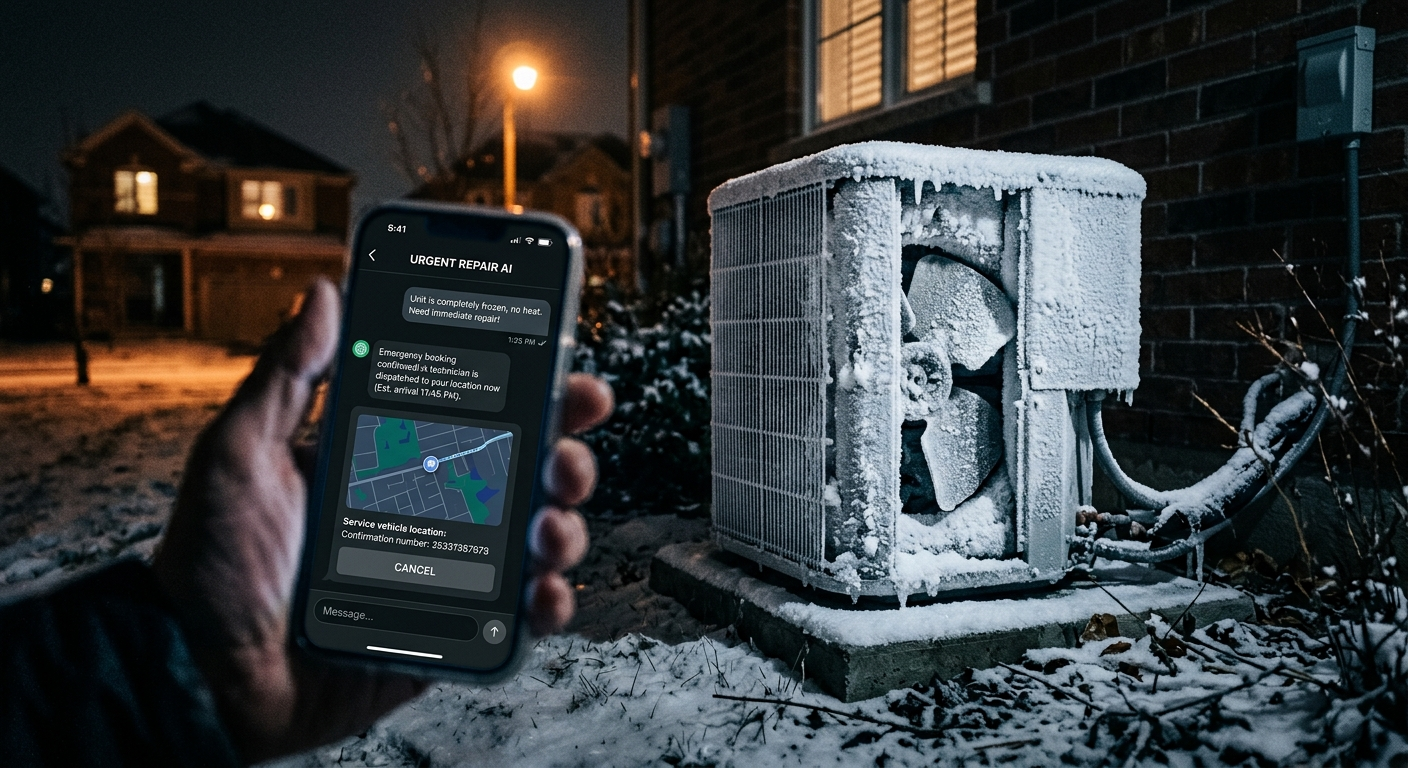
It’s 2:14 AM on a Sunday in January. The temperature outside just dropped to 12 degrees. Your phone rings. You’re dead asleep, your hand swipes the screen, and you miss it by a fraction of a second.
The caller? A panicked homeowner with two kids and a house dropping a degree every twenty minutes.
By the time you call back two minutes later, they’ve already left a voicemail and moved on to the next Google search result. You just lost an $950 emergency ticket—and probably a customer for the next fifteen years.
If you run an HVAC company, this scenario isn’t a hypothetical. It’s a financial leak happening every single week. But the best shops in the US have already plugged the hole, and they did it by letting an AI sales agent answer their emergency calls in 2 seconds flat.
Here is exactly how that works, what the data says, and why your old answering service is quietly killing your revenue.
The Brutal Math on Missed HVAC Calls
Let’s look at the actual numbers. The average emergency HVAC repair ticket in the US sits between $800 and $1,200. If your shop misses just 12 after-hours emergency calls a month—and data shows most small shops miss closer to 20—you are handing $10,000 to $14,000 a month to your competitors.
That’s $120,000 to $168,000 a year ringing straight into the void.
But it gets worse. HVAC is a trust-based, relationship-driven business. When someone calls you at 2 AM, they aren't price-shopping on HomeAdvisor. They are in a crisis, and they called you because your local SEO, your truck wrap, or your neighbor told them you were the expert. When you don’t answer, the psychological contract is broken. They feel abandoned. Even if they call you back on Monday for a standard tune-up, their trust is dented.
Speed to answer isn't just a customer service metric. In emergency sales, speed is the sale.
Why Traditional Answering Services Fail the Panic Test
You might be thinking, "I already pay a service to answer my after-hours calls."
Here is the reality of the traditional call center model: they are message-takers, not sales agents. When a panicked homeowner calls a traditional answering service, the script usually sounds like a robotic interrogation.
"What is your name? What is your address? What is the nature of your emergency? Someone will call you back."
Notice what just happened there? The homeowner is still cold, and they still don't have a technician dispatched. They are just waiting. Studies on customer behavior during service emergencies show that if a resolution isn't initiated within the first 60 seconds of the call, the customer's anxiety spikes, and they immediately start looking for alternative options.
Furthermore, traditional services take an average of 25 to 45 seconds just to patch the call or take down the details. By the time they figure out if you have a tech available, the caller has already hung up and dialed the next guy.
How an AI Sales Angel Handles the Call in 2 Seconds
Answering in 2 seconds isn't a magic trick; it's computing power. When a call hits an AI sales agent, there is no ringing, no transferring, no waking up a disinterested third-party operator. The AI instantly processes the caller ID, pulls up your CRM, and answers with a custom, natural-sounding voice.
But answering fast is useless if the conversation is stupid. Here is how a modern AI sales agent actually handles an HVAC emergency call to close the job.
Instant Triage and Empathy
The AI doesn't sound like a robot. It answers warmly: "Hi, this is the after-hours line for [Your HVAC Company]. I see you're calling at 2 AM—are you dealing with a heating emergency?" It instantly validates the caller's stress and moves to triage.Real-Time Schedule Integration
The AI is connected to your actual dispatch software. It doesn't just say "we'll pass the message along." It knows your techs' schedules. If you have a technician on emergency rotation, the AI says, "I have a technician who can be there by 3:30 AM. Does that work for your family?"Securing the Revenue
Here is where AI beats 90% of human receptionists. The AI captures the dispatch fee or gets a credit card on file to secure the appointment. No-shows on emergency calls cost you fuel and time. By securing payment info during that initial 2-second interaction, the AI ensures that when your tech rolls up at 3:30 AM, the job is locked in.Real-World Example: A Texas Heatwave
Let me give you a real scenario from last July. A mid-sized HVAC shop in Dallas was running a skeleton crew for weekend emergency calls during a 108-degree heatwave. Their traditional answering service was overwhelmed, taking 90 seconds just to answer, and was only successfully booking about 30% of the callers.
They switched to an AI sales agent to handle the overflow. Over that single sweltering weekend, the AI answered 84 after-hours calls in under 2 seconds each. It dynamically booked 62 emergency dispatches by checking the live schedule and securing a $150 dispatch fee on the spot.
That weekend alone generated just over $54,000 in emergency ticket revenue that would have otherwise gone to the massive regional competitors dominating the Google ads. The owner didn't take a single call, but his business captured every single lead.
The Psychology of the 2-Second Answer
Why does answering in 2 seconds make such a massive difference in close rates? Because it hacks the caller's psychology.
When someone is in a crisis—a burst pipe, a dead furnace in a blizzard—their brain is in fight-or-flight mode. If a phone rings four, five, or six times, their brain interprets that silence as abandonment. By the time you answer on ring seven, you aren't talking to a rational consumer; you are talking to an angry, panicked person who is already defensively assuming you are going to rip them off.
When the phone is answered on the very first ring, the psychological shift is immediate. The caller feels relieved. They feel prioritized. Subconsciously, they assume your company is massive, incredibly organized, and highly competent. You haven't even said a word yet, and you've already built trust.
What This Means for Your Business
You didn't start an HVAC company to become a 24/7 dispatcher. You started it to fix systems, build a team, and grow a profitable local business. But in 2026, the expectation of instant communication isn't going away. If a caller can get an immediate answer and a booked appointment from your competitor's AI, your "we'll call you back in the morning" voicemail sounds like a relic from the 1990s.
The technology isn't about replacing your team. It's about acting as an invisible filter. It handles the 2 AM panic calls, qualifies the lead, books the job, and lets your human techs do what they do best—walk in with their tools, fix the problem, and collect the check.
When was the last time you looked at your missed call log on a Sunday morning? How much guaranteed revenue is sitting in that list, already handed over to the guy down the street?
See a live AI Sales Angel in action at angelspok.com
Ready to put AI to work for your sales?
An AI Sales Angel responds in 2 seconds, works 24/7, and costs a fraction of a human salesperson.
Get Your Angel