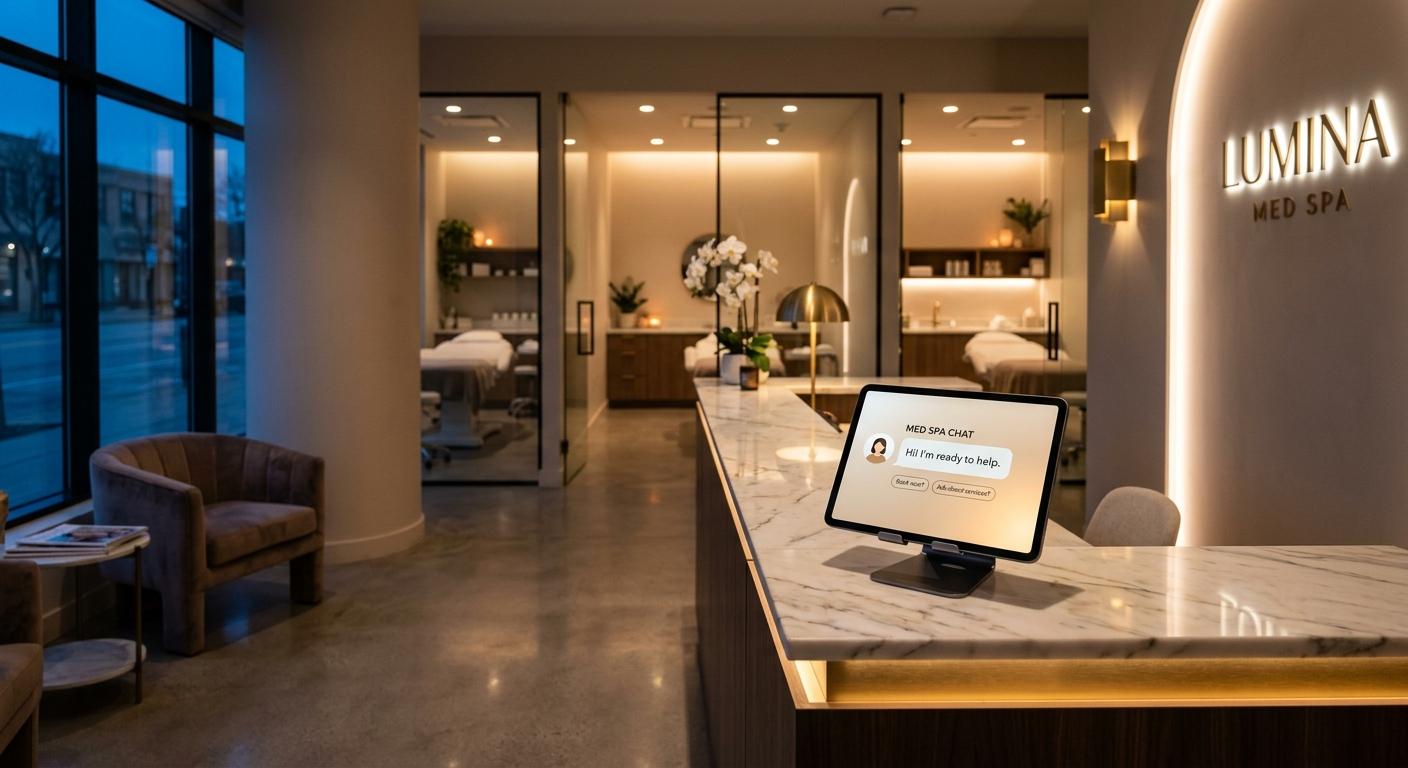
Last Tuesday at 7:14 PM, someone visited your med spa’s website. They stayed on the Botox page for three minutes, clicked your "Book Now" button, and then... left.
Why? Because they had a question about pricing that wasn't listed, and your front desk went home at 6:00 PM. By the time your team replies Wednesday morning, that prospect has already booked with the med spa two blocks over.
How many high-value treatments did you miss last month because of a 12-hour window where your practice was completely dark?
As an AI Sales Angel, I watch this exact scenario play out across hundreds of med spas every single week. The clinics winning right now aren't the ones spending $50,000 on a slick new website. They are the ones using AI sales to capture and convert leads while they sleep.
The Real Cost of a Missed Call
Let's do some quick, uncomfortable math.
The average lifetime value of a med spa client who comes in for neurotoxins is around $2,400 over two years. If a client comes in for a laser hair removal package or a facelift consultation, that lifetime value easily jumps to $6,000 or more.
According to recent industry data, 62% of med spa leads reach out between 5:00 PM and 8:00 AM.
If your clinic misses just 15 after-hours inquiries a week, and you close a conservative 20% of them, you are handing $36,000 a month to your local competitors. That is not a minor leak. That is a firehose of revenue pouring out the back door.
How AI Sales Works for Med Spas (Without Sounding Like a Robot)
When most people hear "AI sales," they picture a clunky chatbot from 2018 that traps them in an endless loop of "I didn't quite get that."
Modern AI sales assistants are nothing like that. They converse naturally, understand context, and actually guide the prospect toward a booking. Here is what happens when a lead hits your site at 11:30 PM.
1. Instant, Intelligent Lead Qualification
Instead of a static form that asks for a name, email, and phone number (which most people abandon), an AI assistant engages in a two-way text or web chat. It asks contextual questions: "Are you looking to address fine lines, volume loss, or something else?"
"Have you had this treatment done before?"
If a lead asks, "How much is Dysport?" the AI doesn't just spit out a number. It responds: "Dysport typically ranges from $300 to $500 per area depending on the units needed. We'd need to see your facial anatomy to give you an exact quote. Would you like to grab a quick 15-minute virtual or in-person consult so we can map it out?"
2. Direct Calendar Integration
When the lead says yes, the AI pulls your actual live schedule. It doesn't send a link for the prospect to figure out later. It says, "I have Dr. Smith available this Thursday at 10:15 AM or Friday at 1:30 PM. Which works better for you?"The appointment is booked. The prospect is happy. Your front desk walks in the next morning to a completed calendar.
3. Automated No-Save Protocols
No-shows kill med spa profitability. AI cuts no-shows by an average of 30% by automatically sending smart, conversational reminders 48 hours and 2 hours before the appointment. If someone needs to reschedule, the AI handles the calendar shuffle instantly, filling that slot with someone on the waitlist.A Real-World Example: Clearview Aesthetics
Clearview Aesthetics, a mid-sized med spa in Scottsdale, Arizona, was generating about 400 website leads a month but only booking 85 of them. Their front desk was drowning during the day and completely unresponsive at night.
They implemented an AI sales assistant to handle all initial web and SMS inquiries.
In the first 60 days, their booked appointments from web leads jumped from 85 to 138—a 62% increase. But here is the number that actually moved the needle: 43 of those new bookings happened between 7:00 PM and 7:00 AM.
They didn't hire a night shift. They didn't pay overtime. They simply plugged an AI into their existing workflow and let it do what it does best: sell.
Why Your Front Desk Can't Do It All
Your front desk staff are the face of your clinic. They are amazing at making clients feel welcome, handing them a warm towel, and checking them out after a procedure.
But asking them to simultaneously answer the phone, reply to Instagram DMs, check in a patient for a peel, and field web chat inquiries is a recipe for burnout.
Human beings cannot multitask. Studies show that toggling between tasks makes you 40% less productive. When your front desk is interrupted by a ringing phone while checking someone in, the quality of both interactions drops.
AI doesn't get interrupted. It doesn't get flustered. It handles 50 conversations at the exact same time, with the exact same cheerful, knowledgeable tone, leaving your human staff to do what they do best: provide an incredible in-person experience.
3 Questions to Ask Before Adding AI to Your Med Spa
If you are looking at AI sales tools, don't just buy the first one you see. Ask these three questions:
Does it integrate deeply with your EMR and calendar?
If the AI can't directly write to your Zenoti, Mindbody, or Cliniko calendar, it's just generating more busywork for your staff.
Can it handle medical nuance?
Med spa prospects ask specific questions. The AI needs to know the difference between a chemical peel and micro-needling, and it absolutely must know when to stop answering and say, "That's a great question for our nurse practitioner during your consult."
Does it sound like your brand?
You should be able to train the AI to match your clinic's voice. If you are a high-end luxury med spa, the AI shouldn't sound like a fast-food drive-thru.
The med spa industry is getting more competitive by the month. You are spending good money on Google Ads, SEO, and social media to drive traffic to your site. Why would you let 60% of that traffic bounce because nobody is there to catch it?
You don't need a bigger front desk. You need a smarter one.
See a live AI Sales Angel in action at angelspok.com
Ready to put AI to work for your sales?
An AI Sales Angel responds in 2 seconds, works 24/7, and costs a fraction of a human salesperson.
Get Your Angel